Advanced Infrared Thermal
Leak Detection in Los Angeles
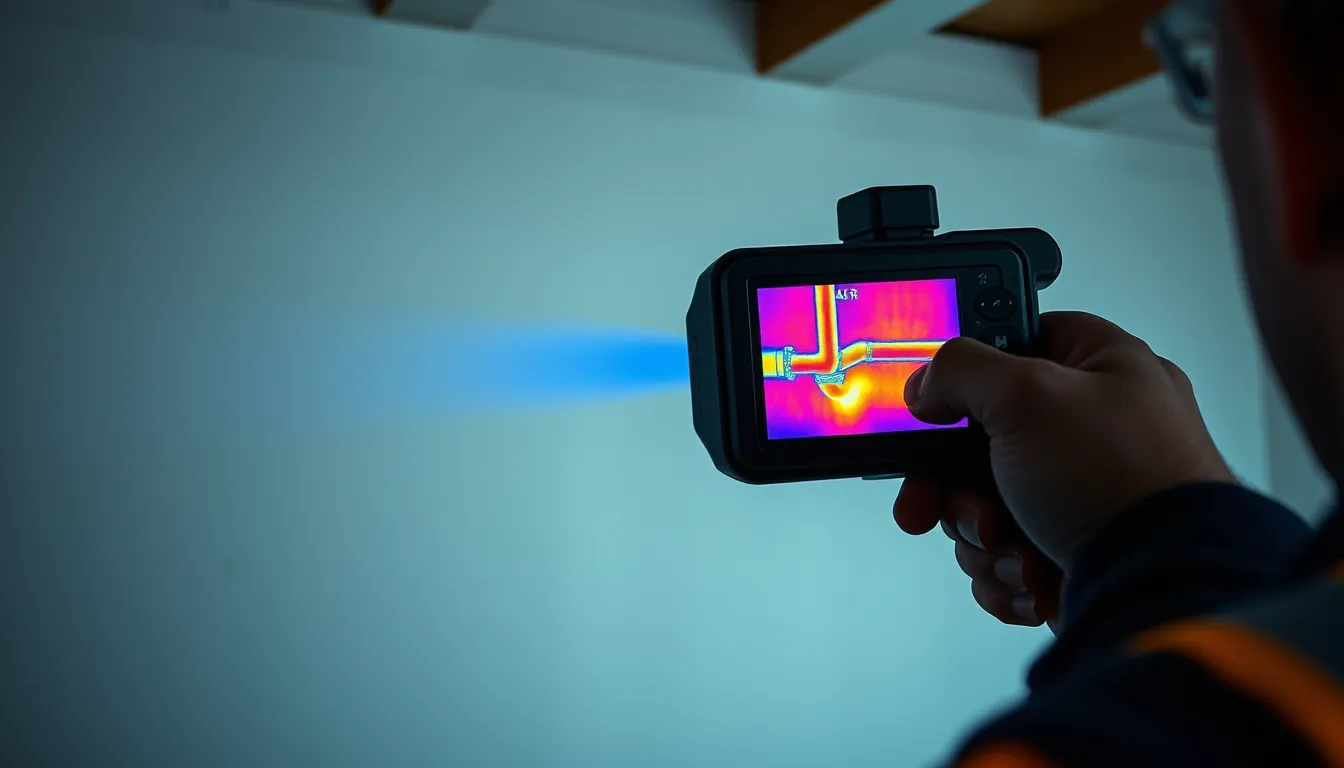
See through drywall and flooring. Our calibrated FLIR thermal cameras expose moisture plumes, hot pipe bursts, and concealed ceiling leaks with zero damage.
Request a Free Estimate
Get a fast response for your Thermal Imaging Leak Detection
When You Need Thermal Imaging Leak Detection: Symptoms & Technical Diagnosis
Identifying subtle indicators of plumbing breaches before catastrophic structural settling or high utility bills occur.
Ceiling Paint Stains & Blistering
Yellow or brownish water rings spreading across lower ceilings beneath upstairs bathrooms.
Persistent Musty Odors Without Water
Distinct mildew smell in bedrooms or hallways with no obvious visible puddles.
Warped Baseboards & Peeling Wallpaper
Baseboards pulling away from drywall or wallpaper bubbling near plumbing risers.
Radiant Floor Heating Inefficiency
Radiant floor zones failing to warm up or displaying cold dead zones across tiles.
Technical Procedure for Thermal Imaging Leak Detection
Our systematic protocol ensures non-destructive accuracy, strict safety compliance, and certified pressure retention.
Thermal Calibration & Differential Setup
We adjust indoor ambient temperatures and introduce hot or cold water through plumbing lines to maximize surface thermal contrast.
High-Resolution FLIR Infrared Sweep
Our certified thermographer sweeps walls, ceilings, and floors with radiometric FLIR thermal cameras sensitive to 0.05°C variances.
Dielectric Moisture Cross-Verification
Thermal anomalies are cross-checked with non-penetrating pinless radio frequency moisture meters to verify true water presence.
Radiometric Digital Report Generation
We deliver full-color thermal imagery reports with exact temperature scales and coordinate markings for insurance adjusters.
How Infrared Thermography Pinpoints Concealed Water Leaks
When pressurized water escapes from a concealed plumbing line, it rapidly migrates through insulation, drywall, framing lumber, and concrete. As water evaporates or introduces a temperature differential (such as heated domestic water or colder ground water), it alters the surface temperature of the wall or floor.
The human eye cannot see these subtle thermal changes until water finally bleeds through paint or causes drywall to buckle. Our military-grade FLIR thermal imaging cameras detect temperature variances as small as 0.05°C.
Combined with non-invasive radio frequency moisture meters, our technicians trace the moisture boundary back to its origin: the precise point where the pressurized pipe is ruptured.
- Concealed second-floor bathroom leaks dripping into lower ceilings
- Radiant floor heating pipe leaks beneath tile, hardwood, or carpet
- Moisture intrusion behind luxury showers, bathtubs, and vanity cabinets
- Wall-enclosed hot and cold water riser failures
- Inaccessible pipe chases in multi-unit condominiums and townhomes
Equipment, Tools & Materials We Deploy
Engineered diagnostic sensors and heavy-duty materials meeting Uniform Plumbing Code (UPC) standards.
| Category | Equipment / Material | Technical Application | Usage Criterion & Standard |
|---|---|---|---|
| Diagnostic | FLIR E8-XT High-Resolution Thermal Camera | Non-contact radiometric infrared thermal inspection across building envelopes | 320x240 thermal resolution with MSX multi-spectral dynamic imaging |
| Diagnostic | Tramex Non-Destructive Moisture Encounter | Measures sub-surface moisture content through drywall, wood, and tile without pin holes | Dielectric radio frequency impedance measurement conforming to ASTM standards |
| Diagnostic | Dual Laser Infrared Thermometer | Validates spot surface temperatures at precise pipe transition intersections | NIST traceable calibration accurate to +/- 0.5°F |
| Safety | Thermal Target Calibration Barriers | Prevents false positive readings caused by solar gain or HVAC vents | Conforms to Infraspection Institute Building Inspection Protocols |
Building Material & Envelope Compatibility
Thermal imaging effectively scans through painted drywall, lath and plaster, acoustic ceiling tiles, ceramic and porcelain floor tiles, laminate, and hardwood flooring. It visualizes both hot water supply leaks (which create elevated heat blooms) and cold water leaks (which produce evaporative cooling thermal depression signatures).
Thermal Imaging vs. Exploratory Drywall Cutting
Objective technical criteria determining whether localized repair or complete line rerouting is the smarter investment.
| Technical Factor | When Localized Repair is Advised | When Complete Replacement / Reroute is Advised |
|---|---|---|
| Surface Intrusion | Multiple wall cuts required to physically view internal pipe chases | 100% non-contact infrared scanning through intact drywall and paint |
| Moisture Boundary Accuracy | Visual staining only shows where water pooled, not where it originated | Color-coded thermal map clearly traces moisture back to exact leak origin |
| Inspection Speed | Hours of manual drywall cuts, dust cleanup, and exploratory inspection | Entire multi-room residence scanned in 45 to 60 minutes |
| Insurance Acceptance | Subjective verbal opinion frequently questioned by adjusters | Certified radiometric digital thermal photographs serving as indisputable proof |
Thermal Inspection Pricing Factors
We provide transparent upfront flat-rate estimates following diagnostic inspection. Final pricing is governed by clear physical parameters:
Single-room localized bathroom scan versus comprehensive multi-story estate inspection.
Structures with heavy solar heat gain on exterior walls requiring evening calibration.
Preparation of itemized engineering reports with annotated thermal images for insurance claims.
Combining thermal imaging with pinless RF moisture meter depth profiling.
Thermal Envelope & Moisture Maintenance
Actionable operational practices to protect domestic water lines and prevent pressure-induced failures.
- Inspect Bathroom Silicone CaulkingRe-caulk shower and bathtub perimeters every two years to prevent wall cavity seepage.
- Inspect Ceiling Under Upstairs BathroomsScan ceiling drywall visually every quarter for early paint yellowing or micro-swelling.
- Service HVAC Condensate LinesClear attic A/C drain pans and overflow switches each spring before hot summer running.
- Check Washing Machine Supply HosesReplace rubber hoses with braided stainless steel lines every 5 years to prevent wall ruptures.
Thermal Imaging vs. Traditional Inspection
Understand why infrared diagnostics should always come before any demolition.
| Inspection Method | Traditional Visual Inspection | Red & Blue Thermal FLIR |
|---|---|---|
| Surface Intrusion | Cutting drywall or pulling baseboards to inspect visually | ✓ 100% non-contact infrared scan through intact surfaces |
| Moisture Mapping | Guessing boundaries based on visible paint discoloration | ✓ Exact color-coded thermal map showing full moisture plume |
| Detection Speed | Hours of manual drywall cuts and flashlight checks | ✓ Full room scanned in minutes with instant digital readout |
| Insurance Evidence | Subjective verbal opinion easily disputed by adjusters | ✓ Certified high-res radiometric thermal photos |
Frequently Asked Technical Questions
Direct, technical answers regarding inspection timeframes, warranty policies, and repair protocols.
Can thermal imaging cameras see through concrete and tile? +
Will thermal imaging help with my homeowners insurance claim? +
Does thermal imaging work on cold water leaks as well as hot? +
Our Los Angeles Service Areas
Serving residential, commercial, and multi-family properties across Los Angeles.
Book a Thermal Leak Detection Scan in Los Angeles
Discover hidden leaks before mold and rot develop. Contact Red & Blue for expert thermal diagnostics.
Request an On-Site Inspection