Non-Toxic Gas Tracer
Leak Detection in Los Angeles
Dealing with an elusive, slow pressure drop that defies standard tools? Our inert nitrogen/helium tracer gas penetrates slabs, asphalt, and earth to reveal microscopic leaks instantly.
Request a Free Estimate
Get a fast response for your Gas Tracer Leak Detection
When You Need Gas Tracer Leak Detection: Symptoms & Technical Diagnosis
Identifying subtle indicators of plumbing breaches before catastrophic structural settling or high utility bills occur.
Microscopic Pressure Drop Defying Acoustic Scans
Plumbing system loses 5 to 10 PSI over 30 minutes, but leak is inaudible to acoustic geophones.
Buried Lines Under Thick Asphalt or Pavers
Underground main lines or pool plumbing buried deep beneath stone pavers where sound is muffled.
Radiant In-Floor Heating Pressure Loss
Closed-loop hydronic heating system boiler repeatedly triggers low-pressure shut-off codes.
Slow Swimming Pool Plumbing Pressure Bleed
Return or suction lines lose pressure slowly without generating audible sound underwater.
Technical Procedure for Gas Tracer Leak Detection
Our systematic protocol ensures non-destructive accuracy, strict safety compliance, and certified pressure retention.
Line Evacuation & Water Purging
The isolated plumbing line is purged of standing water using dry, oil-free compressed air to open the breach orifice.
Tracer Gas Charging (95/5 N2/H2)
We charge the sealed line with certified non-flammable forming gas (95% Nitrogen, 5% Hydrogen) under controlled low pressure.
Surface Molecular Sniffing Sweep
Because hydrogen is the smallest, lightest molecule in the universe, it escapes the pinhole and ascends vertically through concrete and soil.
PPM Peak Localization & Marking
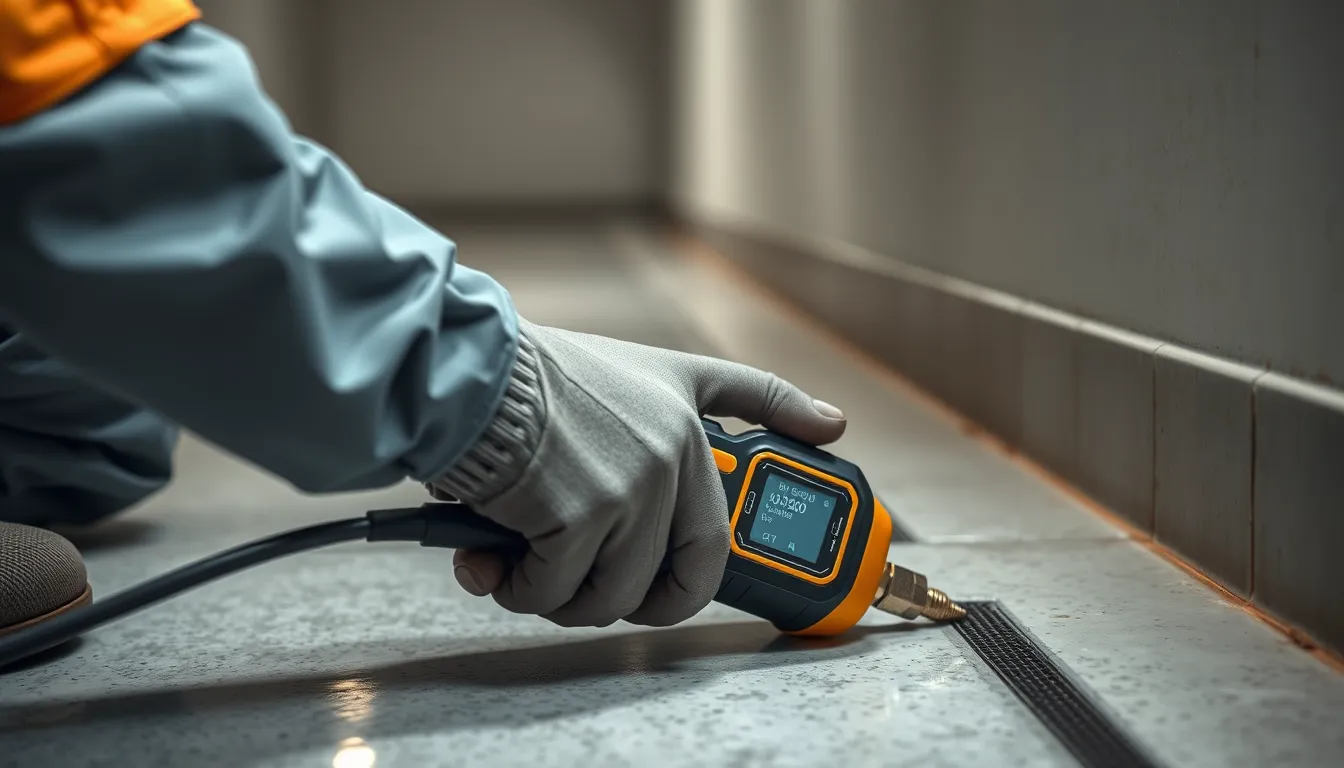
Our digital sniffer probe detects parts-per-million gas concentration spikes directly above the rupture, marking the spot with zero demolition.
The Most Advanced Diagnostic Solution for Elusive Plumbing Leaks
Certain plumbing leaks are notoriously difficult to detect: lines buried deep in wet soil, small pinholes that only leak under pressure fluctuations, or complex manifolds embedded in multi-layered commercial buildings. In these challenging situations, acoustic sound may be muffled and thermal signatures obscured.
Gas tracer testing solves this dilemma through physics. The water line is cleared of water using compressed air, and charged with an inert forming gas mixture. Because hydrogen is the lightest, smallest molecule in the universe, it escapes through the exact leak hole and ascends vertically through soil, concrete slabs, floor tiles, and paving.
Our specialized electronic sniffer sensor sweeps the floor surface. When it detects elevated parts-per-million of tracer gas, an acoustic and visual alarm triggers, confirming the leak origin with absolute mathematical certainty.
- Very slow, microscopic pressure drops on closed plumbing systems
- Buried lines under composite surfaces, thick concrete, or dense asphalt
- Deep agricultural, estate, or commercial irrigation mainlines
- Radiant floor heating circuits that fail pressure holding tests
- Complex swimming pool and spa underground circulation lines
Equipment, Tools & Materials We Deploy
Engineered diagnostic sensors and heavy-duty materials meeting Uniform Plumbing Code (UPC) standards.
| Category | Equipment / Material | Technical Application | Usage Criterion & Standard |
|---|---|---|---|
| Diagnostic | Sensistor Hydrogen / Helium Molecular Sniffer | Detects trace gas concentrations rising through soil, concrete, and asphalt | Sensitivity down to 1 PPM; selective semiconductor sensor eliminating false alarms |
| Material | Certified 95/5 Nitrogen-Hydrogen Forming Gas | Non-flammable, non-toxic tracer gas safe for potable drinking water lines | ISO 14175 certified forming gas mixture; food-grade potable water safe |
| Diagnostic | Digital Nitrogen Pressure Charging Manifold | Injects tracer gas into closed plumbing lines under regulated test pressure | High-precision dual-stage regulator accurate to 0.1 PSI |
| Safety | Overpressure Relief Valve & Purge System | Ensures test gas pressure never exceeds maximum pipe design thresholds | ASME pressure vessel and plumbing system testing safety compliance |
Safe for All Potable and Heating Lines
Tracer gas detection is 100% safe, non-toxic, non-flammable, and approved for residential and commercial potable drinking water lines, radiant in-floor heating loops, swimming pool plumbing, and commercial fire sprinkler mains. It leaves zero chemical residue, odor, or taste in water pipes.
Tracer Gas vs. Standard Diagnostic Tools
Objective technical criteria determining whether localized repair or complete line rerouting is the smarter investment.
| Technical Factor | When Localized Repair is Advised | When Complete Replacement / Reroute is Advised |
|---|---|---|
| Leak Size Capability | Requires loud, rushing water flow to generate detectable acoustic sound | Detects microscopic hairline pinholes leaking as little as one drop per minute |
| Sub-Surface Depth | Sound is muffled and lost in deep clay soil, gravel, or insulation layers | Gas molecules rise naturally and vertically through concrete, earth, and asphalt |
| False Positive Risk | Ambient traffic, running appliances, and wind can mislead acoustic sensors | Virtually zero; sensor reacts strictly to the specific molecular tracer gas |
| Property Demolition | Contractors tear up floors looking for inaudible leaks | 100% non-invasive; pinpoint accuracy achieved without breaking concrete |
Tracer Gas Testing Pricing Factors
We provide transparent upfront flat-rate estimates following diagnostic inspection. Final pricing is governed by clear physical parameters:
Small residential bathroom branch versus sprawling commercial or estate water supply mains.
Draining large plumbing loops with high static water head before gas charging.
Scanning through unsealed concrete and lawn versus dense multi-layer commercial epoxy flooring.
Isolated single-line test versus whole-property elimination testing on unknown manifold configurations.
Plumbing System Integrity Measures
Actionable operational practices to protect domestic water lines and prevent pressure-induced failures.
- Monitor Closed System Pressure DropsPerform annual pressure drop tests on closed hydronic and domestic systems to detect pinholes early.
- Ensure Potable Safe TestingAlways insist on certified non-toxic forming gas for any potable drinking water pipe testing.
- Flush Lines After De-PressurizationFlush domestic taps for 5 minutes after testing to evacuate all ambient air pockets.
- Maintain Proper Boiler Water QualityUse corrosion inhibitors in radiant heating loops to prevent acid pitting of copper tubes.
Tracer Gas vs. Standard Diagnostic Methods
See how molecular gas sniffers solve the toughest leak detection challenges.
| Detection Metric | Standard Acoustic / Thermal | Red & Blue Tracer Gas |
|---|---|---|
| Leak Size Capability | Requires continuous water flow to generate sound/heat | ✓ Finds microscopic pinholes with zero audible sound |
| Surface Penetration | Can be muffled by deep soil, thick gravel, or insulation | ✓ Gas molecules rise cleanly through concrete, asphalt, and soil |
| False Positive Risk | Background noise can mislead acoustic sensors | ✓ Virtually zero; sensor reacts only to specific tracer gas |
| Safety & Sanitization | Uses standard water pressure | ✓ Certified safe for potable water supply lines |
Frequently Asked Technical Questions
Direct, technical answers regarding inspection timeframes, warranty policies, and repair protocols.
Is tracer gas safe for drinking water pipes? +
Will the gas escape into my home and cause issues? +
How small of a leak can tracer gas detect? +
Our Los Angeles Service Areas
Serving estates, residential homes, and commercial facilities throughout Los Angeles.
Struggling with an Elusive, Hard-to-Find Leak?
Trust Red & Blue's advanced molecular tracer gas technology. Call (818) 266-4256 today.
Request an On-Site Inspection